
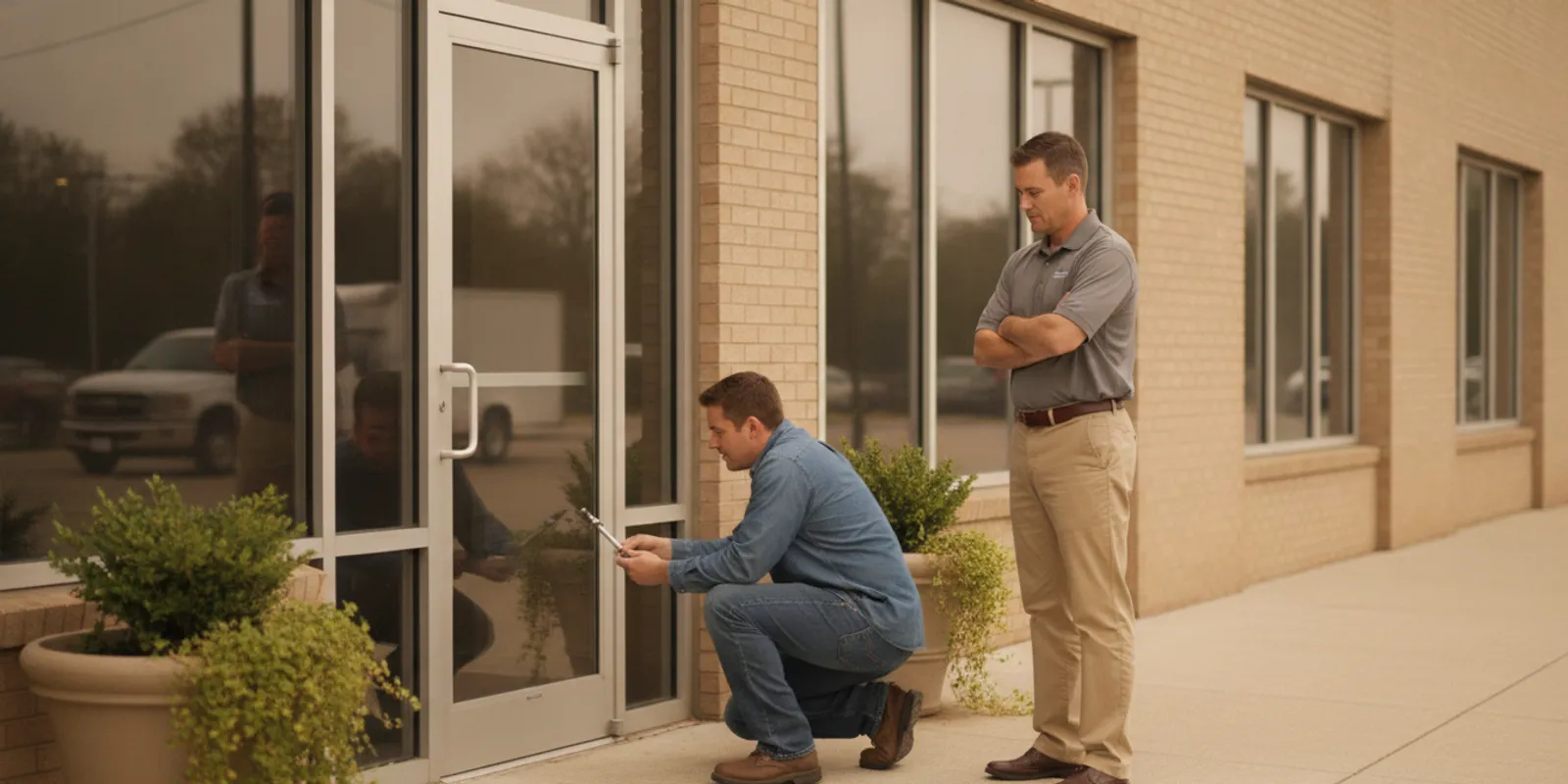
Commercial door repair starts with a clear description of the problem, not an assumption about what part needs replacing. A door that sticks, will not latch, or has visible damage can affect daily access and building operations. The right next step depends on the door’s condition, how it is used, and whether a safe, lasting repair is practical. This guide walks property owners and managers through the decision and planning process.
What should you establish before arranging commercial door repair?
Begin by recording what the door is doing and when the problem occurs. Write down whether it sticks throughout its swing, catches only near the latch, will not close fully, or has become difficult to open. Note whether the issue is constant or intermittent, and whether it began after a particular event such as a forceful impact, a change in use, or recent work nearby. These details help a contractor understand the symptom without treating a first impression as a diagnosis.
Identify the door’s location and role. Is it a main entrance, a staff entrance, an interior passage, or an opening used for deliveries? Record how often it is used and whether people, carts, or equipment pass through. A busy opening may need a different work plan from a seldom-used door. If access needs to remain available during business hours, tell the contractor before a visit so the discussion can include timing and safe access arrangements.
Make a short written record before touching or adjusting anything:
- Describe the symptom in plain language and when it happens.
- Note which door leaf is affected if the opening has more than one.
- Photograph visible damage from a safe distance, including the door edge, frame, and surrounding area.
- Record any recent changes in operation or any previous work you know about.
- List the people who can provide access and answer questions at the site.
Do not force a door that is binding or unstable. Do not remove hardware or attempt a repair if doing so could make the opening harder to secure or create a hazard. If the door is part of a designated fire or life-safety system, follow the building’s established procedures and consult the responsible qualified professional. A brief record is useful; it is not a substitute for an in-person assessment.
Which signs should you record, and what might they indicate?
Several symptoms can feel alike to the person using the door, even though they may have different causes. A dragging edge, a latch that misses, and a loose handle are observations—not conclusive diagnoses. Note the exact point in the door’s movement where the problem appears. That gives the person assessing it a useful starting point and reduces the risk of planning work around a guess.
| What you observe | What to document | What to clarify during the assessment |
|---|---|---|
| Door rubs or drags | Where it catches, whether the mark is new, and whether it happens on opening or closing | Whether the door, frame, hardware, or surrounding opening needs attention |
| Door will not latch consistently | Whether it closes fully, whether the latch meets its opening, and how often it fails | What adjustment or component work is appropriate and how operation will be checked |
| Loose, noisy, or difficult hardware | Which handle, hinge, closer, or other visible part seems affected; do not dismantle it | Whether the part can be serviced or should be replaced, and whether compatible parts are available |
| Visible damage to door or frame | Location, approximate size, and clear photos taken without touching sharp or unstable areas | Whether the affected area is limited or the complete assembly requires a broader scope |
| Door is difficult to secure | When it fails to secure and whether the condition is constant | How to manage access safely until the work is completed |
The table is a planning aid, not a fault-finding chart. Do not assume that a particular symptom has one fixed cause. For example, a latch that misses could involve alignment, hardware, or a change in the opening. A qualified site review is needed to determine the actual scope.
When is repair worth evaluating, and when should replacement be discussed?
Repair may be worth evaluating when the problem appears limited, the door and frame remain serviceable, and the needed work can restore reliable operation. The assessment should identify the specific work proposed and how the contractor will confirm that the door operates as intended. A repair proposal is more useful when it describes the affected components, any assumptions, and what would trigger a change in scope.
Replacement should be discussed when damage is extensive, the door or frame is significantly compromised, a prior repair has not resolved the same problem, or compatible parts cannot be sourced. Replacement may also merit consideration if the opening’s current configuration no longer suits its use. These are reasons to ask questions, not automatic rules: the condition of the complete opening and the building’s requirements matter.
Ask the contractor to explain what can be determined during the initial assessment and what may remain unknown until work begins. If concealed damage is possible, ask how it would be documented, who would approve additional work, and how the estimate would be updated. Clear approval steps help prevent a limited repair conversation from becoming an open-ended project.
When full replacement is under consideration, compare the existing opening with the intended use before selecting a door. Material, size, hardware, traffic, weather exposure, and the need to maintain access may all affect the scope. A replacement is not simply a matter of choosing a new slab: the frame, hardware, fit, and installation plan should be considered together. For steel-door replacement planning, the Steel Door Institute’s commercial steel door installation guide outlines an installation process. It is useful as background on installation, not as a diagnosis or a substitute for a site-specific proposal.
What should a commercial door site assessment cover?
Use the visit to describe how the door is used and what outcome matters most. Reliable latching, easier operation, controlled access, or limiting disruption may be priorities. A thorough conversation should cover the opening as a whole rather than focus only on the most visible piece of hardware.
- Door and frame condition: Ask what the assessor observed on the door, frame, and points where hardware connects.
- Operation: Explain how the door performs during normal use, and identify whether the issue changes with repeated use or different conditions.
- Hardware: Ask which components are included in the proposed work and whether the existing parts can be retained.
- Use and access: Describe traffic patterns, delivery needs, opening hours, and any periods when work would cause a problem.
- Related openings: If other doors have similar symptoms, identify them separately. Do not assume they need identical work.
- Constraints: Share known building rules, access procedures, or documentation requirements that may affect the visit or work plan.
Ask the assessor to separate confirmed observations from items that need further investigation. For instance, a visible scrape is an observation, while its cause may not be established. This distinction makes it easier to understand what the proposed scope addresses and where uncertainty remains.
For an overview of the company’s door-related options, see commercial door services. If a project involves a steel entry door, review the steel entry door information as another reference point. These pages can help frame a discussion; the site visit is where the property-specific needs should be evaluated.
How can you compare commercial door repair proposals fairly?
Do not compare proposals by the headline alone. One may cover a limited adjustment while another includes replacement parts or additional work. Ask each contractor to describe the scope in enough detail that you can see what is included, what is excluded, and what remains conditional. If the proposals address different solutions, ask for the reasoning behind each one before comparing their totals.
A useful proposal should make clear:
- Which door and opening the work covers.
- What work is included, including the identified parts or assembly where applicable.
- Whether the proposal is for repair, replacement, or an assessment followed by a separate decision.
- What assumptions the proposal relies on and what conditions could change the work.
- Whether parts, disposal, and any related work are included or listed separately.
- How the work is expected to affect access and how scheduling will be coordinated.
- What the process is for approving changes before additional work is done.
Ask for clarification in writing if terms such as “adjust,” “service,” or “replace as needed” do not tell you exactly what is planned. For a repair, ask what result will be checked when the job is complete. For a replacement, ask which parts of the opening are included and whether the quote assumes the existing frame can remain. A clear scope lets you compare like with like and spot unanswered questions before approving work.
Cost depends on the actual condition, required parts, scope, and access needs. No reliable estimate can be made from a symptom description alone. Avoid selecting a proposal solely because it is the least expensive or promises the quickest finish; first confirm that it addresses the problem and explains any limits. You can also review available financing information if payment options are part of your planning.
What project records should you keep?
Keep one folder for the issue, assessment, proposal, approvals, and follow-up. Include the original notes and photos, the written scope, any clarifications, and the name of the person who approved the work. If a proposal changes after an opening is inspected, keep both versions and the written explanation of what changed. This gives the property team a simple reference if questions come up later or a similar problem appears elsewhere.
For a building with several doors, label each opening consistently by room, entrance, or another identifier your team already uses. Take separate notes and photographs for each one. Avoid bundling several doors together under a vague description such as “back entrance doors”; a clear label helps confirm which opening was assessed and prevents the wrong work from being approved. Share only the access information needed to coordinate the visit, and follow the property’s normal records and privacy practices.
After completion, save the final scope and any instructions the contractor provides. Note the date the work was completed, who accepted it on behalf of the property, and whether the operation check matched the agreed outcome. If a symptom returns, record when it happened and what you observed. This factual follow-up is more useful than trying another adjustment without knowing whether it is appropriate.
How should you prepare the site and manage access?
Before the visit, arrange access to the door and enough space to inspect it safely. Let the contractor know who will meet them, how to enter the building, and whether there are visitor or work-area procedures. If the affected opening is used for deliveries or customer access, identify an alternate route if one is available. Do not promise that an alternate route is suitable until your building team has checked it.
For scheduled work, confirm the anticipated work area, expected access limitations, and how schedule changes will be communicated. If the door is part of a route used by staff or visitors, decide who will share updates with building occupants. Keep the area clear of stored items where practical, but do not move heavy objects or interfere with equipment if doing so is unsafe. The contractor and property representative should agree on access arrangements before the work starts.
After the work, ask for a demonstration of normal operation and confirm that the door closes and latches as described in the agreed scope. Review any instructions or limitations provided. If the original symptom remains, explain exactly what you observe and contact the contractor promptly rather than attempting an unapproved adjustment.
What questions should you ask before approving the work?
A short list keeps the decision focused. You do not need technical terminology to ask for a clear explanation. Consider asking:
- What did you observe, and which parts of the opening are included in this scope?
- Why do you recommend repair rather than replacement, or replacement rather than repair?
- What is uncertain until work begins, and how will that uncertainty be handled?
- How will the door’s operation be checked after the work?
- What should we do about access while the work is underway?
- Who can approve a change in scope, and will we receive the change and its cost in writing first?
- What information or follow-up should we keep after completion?
Record the answers alongside the proposal and photos. If more than one decision-maker is involved, share the same scope and notes with everyone reviewing it. That prevents different people from comparing different assumptions.
Frequently asked questions
Can I tell what part is failing just by looking at the door?
Sometimes a visible problem can be documented, but appearance alone does not confirm the cause. Record where and when the symptom appears, then have the opening assessed before approving a specific fix.
Should a property manager keep using a door that will not latch?
Do not assume it is safe or secure to keep using it. Follow your building’s access and safety procedures, limit use as appropriate, and arrange a professional assessment. If the door has a designated safety function, involve the responsible qualified professional.
Does every damaged commercial door need to be replaced?
No. The decision depends on the extent of damage, the condition of the frame and hardware, the door’s role, and whether an appropriate repair can restore operation. Ask for the reasons and scope behind the recommendation.
What should I send before requesting an assessment?
Share the building location, door use, a concise description of the symptoms, and a few clear photos if they can be taken safely. Mention access restrictions and the best person to coordinate a visit. You can use the contact and estimate request page to start the conversation.
How can I confirm whether the location is in the service area?
Share the property address when you inquire and ask the team to confirm availability. The service area page provides additional location information, but availability should be confirmed for the specific project.
Discuss your commercial door project
A clear symptom record, an on-site review, and a written scope give you a more dependable basis for choosing the next step. Confirm what is included, how access will be managed, and how any change will be approved before work begins.