
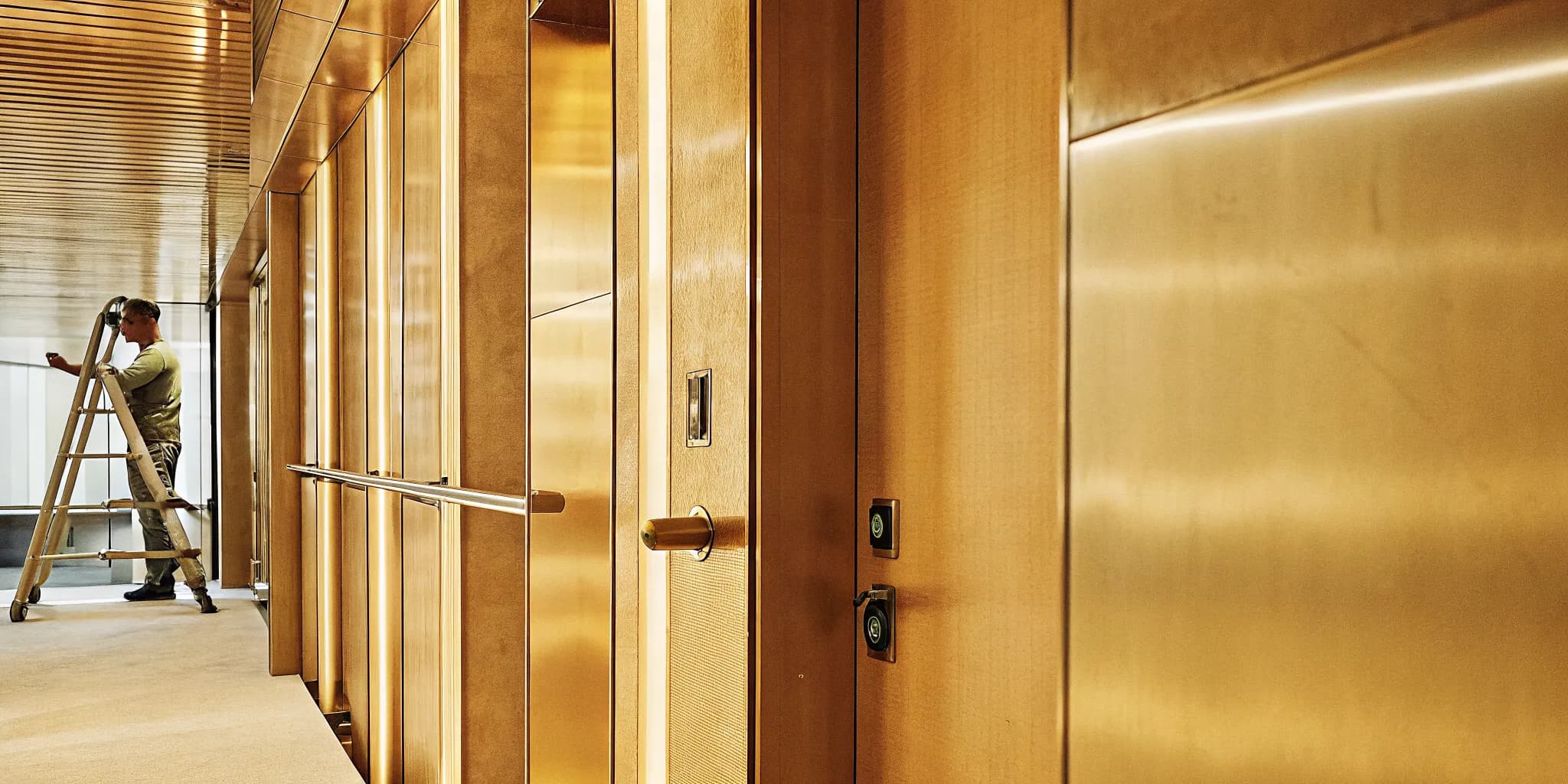
For New Jersey business owners, commercial property managers, and facility directors, compliance with fire safety codes is not merely a legal checkbox; it is a foundational pillar of life safety and property protection. When a fire breaks out, a code-compliant, professionally installed fire door acts as a silent sentinel, containing smoke and flames within designated zones, safeguarding emergency escape routes, and buying precious minutes for building evacuation. However, the path to a fully compliant opening is highly technical. A single incorrect clearance, an unapproved latch, or a mismatched frame can instantly void an assembly's fire rating and lead to failed municipal inspections, hefty fines, or catastrophic liability. Navigating the complex web of local codes and structural requirements demands an experienced hand.
Need code-compliant protection for your facility? Schedule a professional commercial fire door consultation with Cosello Construction today or call our Cherry Hill office directly at (856) 317-1770 for an expert project assessment.
commercial fire door installation nj is the highly regulated process of planning, mounting, and certifying tested opening protectives within fire-resistance-rated walls across New Jersey commercial facilities. Governing regulations, including the New Jersey Uniform Construction Code (UCC) and NFPA 80, dictate that fire doors are not standalone slabs, but rather complete, matched assemblies comprising the door leaf, frame, anchors, hinges, closing devices, positive-latching hardware, gaskets, and certified labeling. To maintain compliance and pass inspections by the local Authority Having Jurisdiction (AHJ), every component of the assembly must carry compatible third-party listings from accredited laboratories such as Underwriters Laboratories (UL) or Intertek (Warnock Hersey). Commercial property managers must avoid common installation pitfalls, such as improper clearance gaps, unapproved field alterations, and painted-over labels, and partner with certified installers who back their work with clear warranties. NFPA 80 additionally mandates documented annual inspections, making precise initial installation the single most cost-effective way to prevent ongoing compliance failures and secure building insurance validity.
Whether you are overseeing a new commercial build, retrofitting an older South Jersey office complex, or resolving municipal code violations, understanding the nuances of professional installation is critical. This comprehensive guide breaks down everything commercial operators must know about fire door installation standards, material selections, code requirements, and cost factors in New Jersey and the surrounding Tri-State area.
What Is Commercial Fire Door Installation and Why Is It Critical in New Jersey?
To understand why commercial fire door installation is treated with such high regulatory scrutiny, one must look beyond the physical door itself. In commercial architecture, walls are designed with specific fire-resistance ratings (such as 1-hour, 2-hour, or 4-hour barriers) to compartmentalize buildings. These barriers prevent a fire from spreading rapidly from its point of origin (such as a mechanical room, laundry suite, or commercial kitchen) into common corridors, exit stairs, and adjacent spaces.
However, walls must have openings for traffic flow. Every door cut into a fire-rated wall represents a potential weak point in the fire barrier. If a fire door fails to close, latches incorrectly, or warps under heat, the fire protection system collapses, allowing toxic smoke and fire to breach the compartment. Therefore, a fire door installation is designed to protect these structural openings by restoring the integrity of the rated wall.
The Assembly Principle: Leaf, Frame, and Hardware
The single most important concept in fire door compliance is the assembly principle. Under NFPA 80 (Standard for Fire Doors and Other Opening Protectives), a fire door is never certified as a singular piece of wood or steel. Instead, the certification applies to the entire opening assembly, which includes:
- The Door Leaf: The physical door slab, constructed from hollow metal steel or solid-core wood, carrying a specific fire rating (e.g., 20, 45, 60, 90, or 180 minutes).
- The Door Frame: The steel or metal frame, which must be rated to match or exceed the required opening rating and must be anchored to the wall assembly using approved anchoring methods.
- Hinges or Pivots: Heavy-duty, ball-bearing steel hinges designed to withstand high temperatures without shearing or melting.
- Latching Hardware: Active latching mechanisms (such as cylindrical locks, mortise locks, or fire exit hardware) that physically hold the door shut against the high positive pressure generated by a fire.
- Closing Devices: Heavy-duty commercial door closers that ensure the door automatically swings closed and fully latches after every single use.
- Gaskets and Seals: Smoke seals and intumescent gaskets that expand under heat to block hot gases, smoke, and drafts from passing through the clearance gaps.
- Certified Labeling: Permanent, legible metal or embossed labels on the door leaf edge and the frame throat, identifying the testing agency, rating duration, and manufacturer.
If any single component is missing, damaged, unrated, or mismatched, the entire assembly loses its certification, and the opening is deemed non-compliant under New Jersey law.
The Life-Safety and Liability Risks of Improper Installation
Partnering with a non-specialist or attempting an undocumented field modification carries extreme risks. If a fire door drags on the floor, has a latch that sticks, or uses an incorrect closer, it may remain slightly ajar during an emergency. In a fire, hot gases will quickly seek out this opening, rendering exit corridors impassable due to smoke inhalation, the leading cause of fire-related fatalities. Additionally, New Jersey local fire marshals, insurance underwriters, and building inspectors perform rigorous field audits. A single non-compliant clearance gap or a painted-over label will result in a failed inspection, halting business operations, delaying certificate of occupancy approvals for new renovations, and exposing property owners to severe legal liability.
New Jersey Building Codes and Standards Governing Fire Doors (IBC & NFPA 80)
New Jersey commercial properties operate under a strict regulatory framework. Building and fire safety compliance is governed by the state-level New Jersey Uniform Construction Code (UCC), which is administered by the Department of Community Affairs (DCA). The UCC adopts the International Building Code (IBC) as its core structural standard, alongside the New Jersey State Fire Prevention Code, which adopts NFPA 80 as the authoritative standard for fire doors.
Adoption of the IBC and State Amendments
New Jersey currently references the 2021 edition of the IBC with specific state-level amendments. IBC Chapter 7 (Fire and Smoke Protection Features) dictates exactly where fire-rated openings are required in a building layout and establishes the required ratings for those doors based on the rating of the surrounding walls. For example, openings in 2-hour fire barriers, such as exit stairwell enclosures, typically require a 90-minute (1.5-hour) fire door assembly. Corridors with a 1-hour rating in sprinklered commercial buildings generally require 20-minute fire-rated assemblies.
NFPA 80: The Installer's Rulebook
While the IBC tells you where fire doors must go and what rating they must have, NFPA 80 dictates exactly how those doors must be installed, inspected, and maintained. For installers, NFPA 80 is the ultimate source of truth, enforcing strict physical tolerances that must be verified during installation:
| Requirement Category | NFPA 80 Standard Tolerance Limit | Inspection Impact / Consequences of Violation |
|---|---|---|
| Top & Side Clearance Gaps | Maximum 1/8 inch (3.2 mm) for steel doors; 1/8 inch for wood doors | Excessive gaps allow smoke bypass and void the assembly's positive-pressure rating. |
| Bottom Clearance Gap | Maximum 3/4 inch (19 mm) between the bottom of the door and the floor | Gaps larger than 3/4 inch require specialized fire-rated sweeps or thresholds. |
| Meeting Stiles (Double Doors) | Maximum 3/16 inch (4.8 mm) for wood doors; 1/8 inch for steel doors | Requires a coordinator device to ensure doors close and overlap in the correct sequence. |
| Label Legibility | Must remain completely visible, unpainted, and un-scraped | Painting over a metal certification label voids the rating and results in an automatic inspection failure. |
| Field Alterations | Strictly limited; maximum 3/4-inch round holes for locks/hardware | Any unapproved drilling, cutting, or trimming voids the certification label. |
Understanding Fire Door Ratings: The Correlation Matrix
When executing a commercial fire door replacement, the rating of the new assembly must align precisely with the fire-resistance rating of the wall. Under IBC Table 716.1(2), the standard correlations are as follows:
- 4-Hour Fire Wall: Requires a 3-Hour (180-minute) rated door assembly (typically designated as a Class A opening).
- 2-Hour Fire Barrier / Shaft Enclosure: Requires a 1.5-Hour (90-minute) rated door assembly (Class B opening).
- 1-Hour Fire Barrier / Exit Enclosure: Requires a 1-Hour (60-minute) or 1.5-Hour door assembly depending on the building classification.
- 1-Hour Fire Partition / Corridor Wall: Requires a 20-minute (Class C) or 45-minute rated door assembly.
At Cosello Construction, our project managers verify your building's original architectural plans, door schedules, and local New Jersey municipal amendments to ensure the correct ratings are ordered, avoiding costly lead-time delays and code mismatch errors.
Core Materials: Hollow Metal vs. Solid Core Wood Fire Doors
Selecting the right material for your commercial fire doors is a critical decision that impacts not only code compliance but also durability, security, thermal efficiency, and interior aesthetics. The two dominant materials used in commercial fire door construction are hollow metal steel and solid-core wood. Each has distinct performance profiles and optimal applications.
1. Hollow Metal Steel Fire Doors
Hollow metal steel doors represent the gold standard for heavy-duty commercial applications, exterior entries, and high-rating compartments. Constructed from heavy-gauge galvanized or cold-rolled steel (typically 18-gauge to 14-gauge for commercial grade), these doors feature internal steel stiffeners and are filled with insulating cores such as polystyrene, polyurethane, or mineral honeycomb.
- Durability and Security: Hollow metal doors are incredibly resilient, resisting physical impact, forced entry, and harsh weather. They are ideal for high-traffic service corridors, loading docks, and exterior exit-discharge points.
- Maximum Fire Performance: Steel is inherently non-combustible. Hollow metal doors can easily achieve fire ratings of 1.5 hours, 2 hours, and up to 3 hours, making them mandatory for high-hazard partitions, elevator shafts, and utility enclosures.
- Hollow Metal Frames: To maintain rating integrity, steel doors must be hung in matched hollow metal steel frames. These frames are custom-anchored into masonry, concrete, steel-stud, or wood-stud wall assemblies using specialized anchoring clips and are often backfilled with mortar or plaster for maximum stability.
2. Solid-Core Wood Fire Doors
For office interiors, upscale retail storefronts, luxury multi-unit residential hallways, and hospitality spaces, hollow metal doors can feel overly industrial. Solid-core wood fire doors bridge the gap between safety and style. Crafted with mineral composite cores, particleboard cores, or laminated lumber cores wrapped in real wood veneers or high-pressure laminates (HPL), these doors provide a premium, warm finish.
- Rating Limitations: Wood fire doors can achieve fire ratings of 20 minutes, 45 minutes, 60 minutes, and up to 90 minutes. They are not suitable for 3-hour fire walls but are highly effective for corridor entrances, hotel guest rooms, and conference suite separations.
- Acoustic Insulation: The dense solid or mineral cores of wood fire doors provide exceptional acoustic dampening, making them ideal for commercial office spaces where speech privacy is a priority.
- Aesthetic Flexibility: Available in dozens of wood species, grain patterns, stains, and paint-grade finishes, wood fire doors allow property managers to maintain a unified design language throughout their facility without compromising safety.
Fire-Rated Glazing (Vision Panels)
Many commercial openings require visibility, such as exit doors in high-traffic school corridors or entry doors to commercial office suites. Standard tempered or plate glass will shatter instantly under the extreme thermal shock of a fire, allowing fire and smoke to breach the opening. Therefore, fire-rated doors requiring glass must use certified fire-rated glazing assemblies:
- Polished Wire Glass: A traditional option featuring an embedded wire mesh. While effective at holding glass intact during a fire, wire glass has limited impact resistance and is increasingly restricted in high-hazard areas like gymnasiums.
- Ceramic Glazing (e.g., FireLite): A modern, high-performance ceramic glass that withstands temperature changes up to 1,600°F without cracking, providing completely clear visibility and high impact safety ratings.
- Intumescent Glazing: Multiple layers of glass separated by clear intumescent gel. In a fire, the gel expands to create an opaque thermal barrier, blocking radiant heat transfer as well as flames.
The size of the vision panel is strictly regulated. For example, a 90-minute fire door is limited to a maximum glass area of 100 square inches per leaf under standard code, while 20-minute doors allow much larger vision areas. Our team at Cosello ensures that all installed glass and glazing beads carry the matching certified fire-rating labels.
Step-by-Step Commercial Fire Door Installation Process
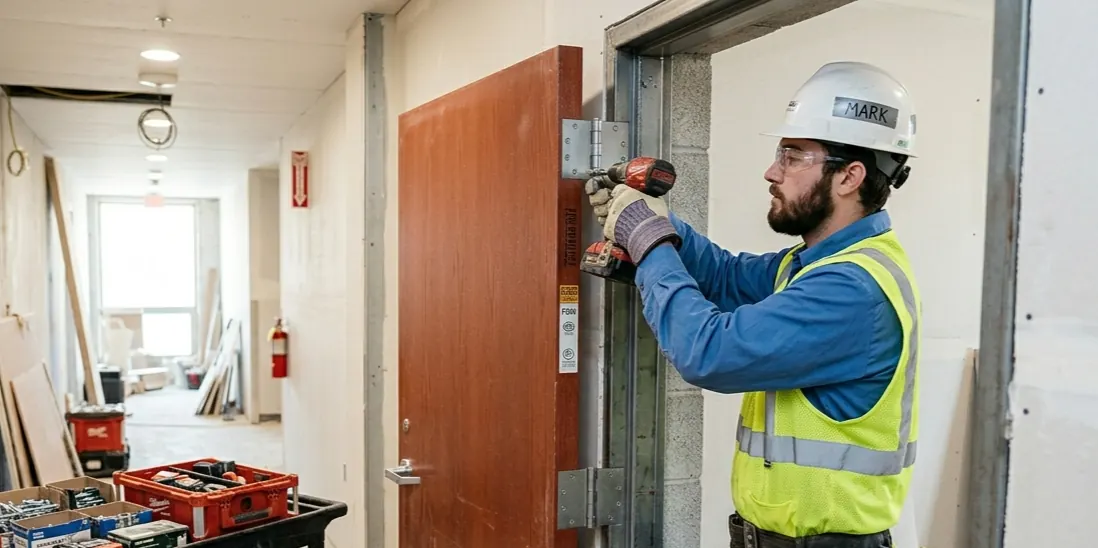
Commercial fire door installation is a precise craft where millimeters represent the difference between code compliance and inspection failure. At Cosello Construction, our certified installation technicians follow a rigorous, documented multi-step sequence to guarantee every opening performs flawlessly and passes local New Jersey fire marshal reviews on the first attempt.
Phase 1: Pre-Installation Inspection and Preparation
Before any physical installation begins, our technicians perform a comprehensive site check. We inspect the structural wall opening for plumb, level, and structural integrity. Whether the opening is in a concrete masonry unit (CMU) block wall, structural steel framing, or wood framing, we verify that the surrounding wall is rated to support the fire door and frame assembly. We check the physical dimensions of the opening and verify the door schedule against the architectural prints. Importantly, we inspect the labels on both the new door leaf and the frame to ensure they are present, legible, and match the required project specification.
Phase 2: Anchoring and Setting the Steel Frame
The frame is the structural foundation of the entire assembly. A poorly set frame will cause the door leaf to drag, sag, or fail to latch. We set the metal frame in the opening, using precision levels and lasers to verify that the head is perfectly level, the jambs are dead-plumb, and the frame is completely square. We then anchor the frame to the wall structure using certified anchoring fasteners. For drywall and metal stud walls, we use heavy-duty compression anchors or steel stud anchors; for masonry walls, we deploy masonry wire anchors or expansion bolts. Once anchored, frames in high-rating applications are often grouted or backfilled with mortar to prevent heat and smoke from creeping behind the steel profile.
Phase 3: Hanging the Door Leaf and Aligning Clearances
With the frame secured, we mount the door leaf using heavy-duty, ball-bearing steel hinges. Because steel and wood doors are incredibly heavy, the hinges must be perfectly aligned to prevent sag over time. Once the door is hung, we perform a series of precision measurements using steel gauges to verify that the clearance gaps conform strictly to NFPA 80 tolerances: top and side clearances must not exceed 1/8 inch, and bottom clearances must be under 3/4 inch. If the floor is uneven, we coordinate the installation of fire-rated thresholds or drop-down automatic door bottoms to seal the lower gap.
Phase 4: Integrating Rated Hardware and Active Latching
Latching and closing hardware are the active safety mechanisms of a fire door. We install certified, heavy-duty commercial door closers that are rated for the door's weight and traffic volume. We adjust the closer's sweeping and latching speeds to ensure the door closes smoothly and quiet, yet firmly engages the latch. We then mount the active latching hardware, such as heavy-duty cylindrical locks, mortise locksets, or fire exit panic hardware. NFPA 80 requires that fire doors be **positively latched**, meaning the latch bolt must automatically engage the strike plate and lock the door shut when closed. Standard roller latches or magnetic-only latches are strictly prohibited on fire doors. For pairs of double doors, we install a **coordinator device** to ensure the inactive leaf closes completely before the active leaf swings shut, allowing the overlapping rabbeted edges to seal correctly.
Phase 5: Deploying Intumescent Seals and Gaskets
To block the passage of cool drafts and toxic hot smoke, we apply specialized, fire-listed seals around the perimeter of the frame. We install smoke-gasketing along the jambs and header. For higher-rated openings, we deploy **intumescent gaskets**. Under the high heat of a fire, this material chemically reacts and expands up to 20 times its original volume, completely sealing any remaining clearance gaps and creating an airtight, fire-impermeable barrier.
Phase 6: Quality Control Testing and Certification Verification
Once fully assembled, our lead technician performs a rigorous, 10-point operability test. We open the door to various angles, including wide-open and just a few inches from the latch, and verify that the closer reliably shuts and latches the door every single time. We verify that all certification labels are fully exposed, clean, and unpainted. We document the installation with high-resolution photos and fill out an NFPA 80 installation compliance checklist, which is placed in the property owner's file for municipal review.
Ensure your project is executed to these meticulous standards. Contact Cosello Construction's commercial door team today to review your project scope or request a detailed installation estimate.
How Much Does Commercial Fire Door Installation Cost in NJ?
Budgeting for a commercial fire door project requires an understanding of the multiple variables that influence the final cost. Because fire doors are highly specialized, certified assemblies rather than standard doors, their pricing is higher than typical commercial or residential openings. In New Jersey, the total cost for a professional fire door installation typically ranges from $1,800 to $4,500+ per opening, including materials, code-compliant hardware, and labor.
Key Cost Drivers in Commercial Installations
- Door Material and Rating: A standard 20-minute wood fire door for an office corridor is significantly less expensive than an 18-gauge, 3-hour rated hollow metal exterior door. Higher fire ratings require denser mineral cores and heavier steel construction, driving up the raw material cost.
- Hardware Complexity: Basic commercial locksets and standard closers represent the entry-level cost tier. However, if your facility requires panic bars, electromagnetic hold-open devices linked to your building's fire alarm system, automatic drop-down door bottoms, or heavy-duty delayed-action closers, hardware costs can easily exceed the cost of the door leaf itself.
- Access Control Integration: Modern commercial properties often integrate fire doors with electronic card readers, keypad locks, or biometric security. Integrating these systems with fire doors requires specialized fail-safe hardware (such as electric strikes or electrified mortise locks) that automatically unlocks during a fire alarm to allow free emergency exit, adding significantly to material and wiring labor costs.
- Structural Opening Modifications: In retrofit projects, the existing wall opening may be out of plumb, damaged, or unrated. Modifying the wall structure, reinforcing studs, or repairing masonry to accept a new rated steel frame requires skilled carpentry or masonry labor, increasing the project scope.
- Municipal Permitting Fees: Local New Jersey building departments charge permit fees for commercial alterations. Permit costs vary by municipality (e.g., Cherry Hill, Camden, or Philadelphia) and typically scale with the overall project value.
Cost Comparison Table: Typical Commercial Openings
To assist property managers in their capital planning, the table below outlines typical budget ranges for standard commercial fire door configurations in the New Jersey and Philadelphia markets:
| Opening Type & Application | Standard Fire Rating | Material & Hardware Spec | Estimated Cost Range (Installed) |
|---|---|---|---|
| Standard Office Corridor / Guest Room Entry | 20-Minute | Solid-core wood door, steel frame, standard closer, cylindrical commercial lockset | $1,800 to $2,500 |
| Utility / Mechanical / Electrical Room | 90-Minute | 18-Gauge hollow metal steel door, steel frame, heavy-duty closer, active mortise latch | $2,200 to $3,200 |
| High-Traffic Stairwell / Exit Enclosure | 90-Minute | Hollow metal steel door, steel frame, commercial closer, fire-exit panic hardware | $2,800 to $4,000 |
| Access-Controlled Facility Fire Barrier (Double Doors) | 90-Minute | Pair of hollow metal doors, steel frame, dual closers, coordinator, panic hardware, electric strikes linked to alarm | $5,500 to $8,500+ |
While the initial investment in professional installation may seem higher than hiring a general handyman, it is the single most effective way to prevent future financial losses. A single failed fire inspection can result in immediate fines and costly project shutdown orders. More importantly, if a non-compliant door fails during a fire, the resulting property damage, insurance claim denials, and legal liability can easily devastate a business. Working with an experienced, fully licensed contractor like Cosello Construction ensures your project is completed correctly the first time, protecting your occupants and your bottom line.
Sector-Specific Requirements: Multifamily, Healthcare, and Commercial Buildings
Fire door compliance is not a one-size-fits-all discipline. Different commercial sectors operate under distinct occupancy classifications within the International Building Code, which translates to specialized fire door installation and hardware requirements. Here is a breakdown of the unique compliance landscapes across New Jersey's primary commercial verticals.
1. Multifamily and Apartment Buildings (Residential Group R)
In multifamily housing, including apartments, condominiums, and senior living facilities, fire doors serve a critical dual role: they protect individual tenant residences from common hallway fires and secure exit stairwells. Key requirements include:
- Corridor Entries: Individual apartment entry doors leading to common hallways must be rated for a minimum of 20 minutes and must be equipped with self-closing and positive-latching hardware to prevent a tenant's door from remaining open if they evacuate.
- Draft and Smoke Control: Under NJ UCC amendments, apartment entry doors must carry a "U" or "S" label, certifying they are rated for draft and smoke control. This requires the installation of perimeter smoke gasketing to block lethal carbon monoxide and smoke from entering hallways.
- Acoustic and Aesthetic Appeal: Property managers typically select solid-core wood fire doors for residential entries to provide sound privacy for tenants and match the building's interior styling.
2. Healthcare Facilities (Institutional Group I)
Hospitals, surgical centers, nursing homes, and assisted living facilities operate under the strictest fire and life safety standards in the country. Because patients in these facilities may be non-ambulatory or confined to beds, evacuation is highly complex, relying heavily on "defend-in-place" strategies. Healthcare compliance requires:
- Smoke Barrier Doors: Healthcare corridors are divided by cross-corridor double doors that serve as smoke barriers. These doors must have certified fire-rated glazing, must be self-closing, and must utilize automatic electromagnetic hold-open devices linked directly to the building's central fire alarm system.
- Positive Latching and Gasketing: Patient room doors must be equipped with positive-latching hardware (such as hospital-grade roller latches or silent mortise locks) and complete smoke seals. Gaps are audited to the millimeter during Joint Commission (TJC) and NJ Department of Health inspections.
- Impact Resistance: Because healthcare doors are constantly subjected to impact from gurneys, wheel stretchers, and food carts, they require heavy-duty armor plates, kick plates, and durable edge guards that do not interfere with the door's fire labeling.
3. Commercial Offices, Retail, and Mixed-Use Buildings (Groups B & M)
For standard office buildings, retail shops, warehouses, and mixed-use commercial centers, the focus centers on high durability, occupant security, and clean egress paths:
- Stairwell and Exit Doors: Stairwell enclosure doors require 60-minute or 90-minute ratings and must use fire-exit hardware (panic bars) that allow occupants to exit instantly by simply pushing the bar. Lever handle locks must be fail-safe to prevent trapping occupants.
- Tenant Separations: Demising walls separating different businesses within a shopping center or office floor must use rated fire barrier walls, with all interconnecting doors rated to match.
- High-Traffic Durability: Main entry corridors require heavy-duty, Grade 1 commercial hardware and robust steel frames that withstand hundreds of daily cycles without sagging or losing alignment.
Professional Certification and Contractor Standards in New Jersey
Because commercial fire door installation directly impacts occupant safety and building compliance, New Jersey enforces strict licensing and contractor standards. Commercial property owners should never delegate fire door work to a residential handyman or an unlicensed subcontractor. Working with a dedicated, experienced commercial door contractor is essential for several key reasons:
1. Verified State Licensing and Insurance
Under New Jersey law, commercial construction, structural alterations, and life safety system installations must be executed by fully licensed contractors. Cosello Construction holds active commercial contractor licenses across New Jersey, Pennsylvania, and Delaware. We carry comprehensive liability insurance and commercial worker's compensation, completely shielding our clients from project-site liabilities and ensuring all work meets local structural codes.
2. Certified Expertise and NFPA 80 Competency
Our installation technicians are highly trained specialists who understand the intricate physical tolerances, hardware specifications, and testing protocols required under NFPA 80. We know how to properly anchor frames into various wall types, adjust delayed-action closers for ADA compliance, and install complex fire-exit panic hardware. We stay updated on the latest building code adoptions and municipal amendments across South Jersey and the Philadelphia metro area, ensuring your project passes fire marshal audits seamlessly.
3. The Cosello Construction Advantage
For over 20 years, Cosello Construction has served as the trusted partner for commercial property owners, facility managers, and general contractors across South Jersey, Philadelphia, and the surrounding Tri-State area. We combine a deep understanding of local building codes with experienced, in-house technicians, prompt 2-week turnaround goals, and a comprehensive 2-year labor warranty to deliver unmatched value on every project.
- Experienced, In-House Technicians: We do not rely on unverified, third-party subcontractors. Our boots-on-the-ground installation crews are experienced, dedicated Cosello employees who treat your facility with the utmost respect.
- 2-Week Turnaround Goals: We understand that facility downtime and code violations must be resolved swiftly. We work closely with leading manufacturers to secure fast material lead times and aim to complete most installations within two weeks of material delivery.
- Comprehensive 2-Year Labor Warranty: We stand behind the quality of our craftsmanship. While many commercial contractors offer only a standard 1-year warranty, Cosello backs every single door and window installation with our comprehensive 2-year labor warranty, giving you long-term peace of mind.
Work with the region's trusted commercial installation experts. Request a free quote from Cosello Construction today and let us handle your compliance needs with precision and care.
Annual Fire Door Inspections (NFPA 80 Compliance)
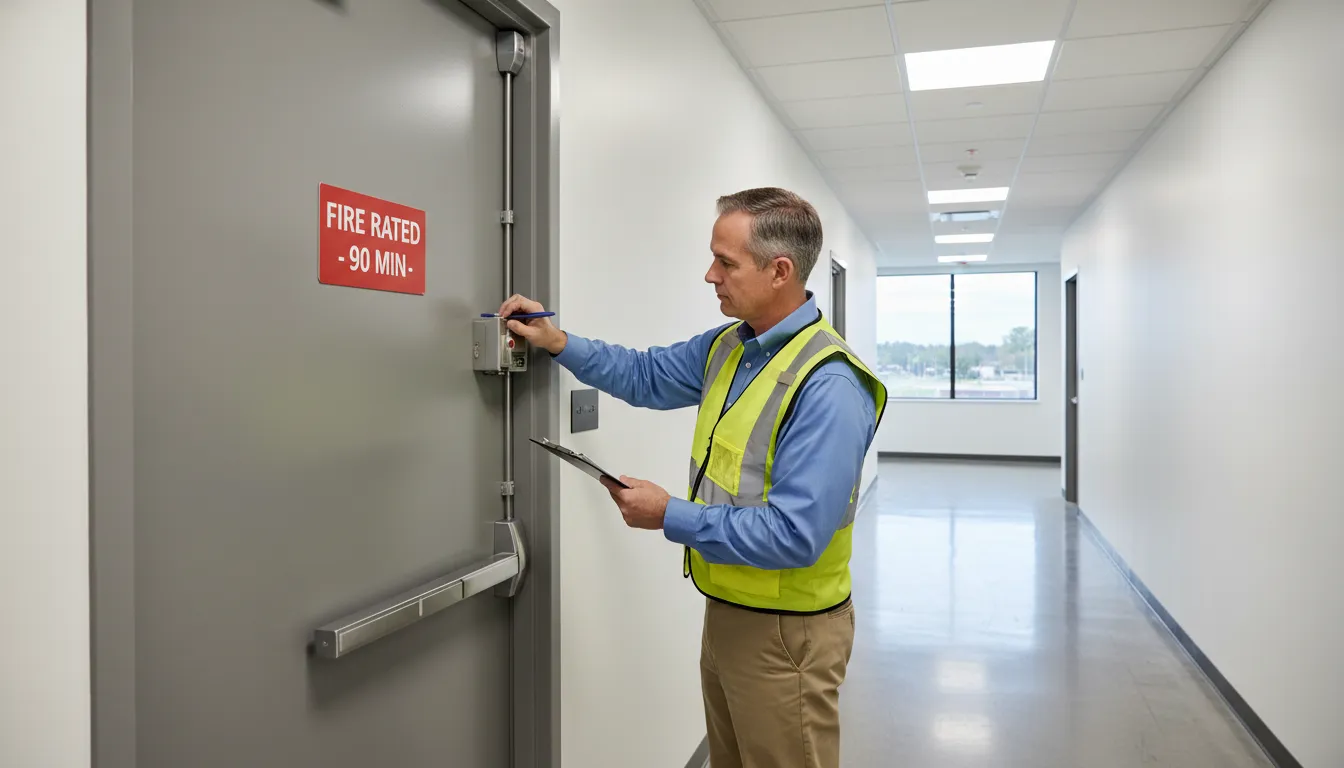
Completing a code-compliant installation is only the first phase of commercial property compliance. Under the International Fire Code (IFC) and NFPA 80 Section 5.2, all commercial facilities are required to perform and document **annual fire door inspections**. These inspections must be executed by a qualified individual, and signed, written records must be kept on-site for immediate review by the local fire marshal.
The 13-Point NFPA 80 Inspection Checklist
During an annual audit, the inspector evaluates the entire opening protective against 13 strict performance criteria:
- Label Verification: Fire labels on the door leaf and frame must be present, legible, and unpainted.
- Damage Inspection: No physical holes, breaks, or cracks must exist in the door, frame, or glazing.
- Component Alignment: The door, frame, hinges, hardware, and thresholds must be securely aligned, with no missing or loose fasteners.
- Closing Device Function: Self-closing devices must operate smoothly and fully return the door to the closed position from various angles.
- Positive Latching: The active latch bolt must securely engage the strike plate every single time the door closes.
- Hardware Integrity: No auxiliary hardware (such as surface bolts, hook-and-eye latches, or manual door wedges) must be installed that interferes with door operation.
- Double Door Coordination: Pairs of doors must be equipped with active coordinators that function in the correct sequence.
- Clearance Measurements: Gaps at the header, jambs, and meeting stiles must not exceed 1/8 inch (3/16 inch for wood double doors), and bottom clearances must be under 3/4 inch.
- Glazing and Light Frames: Glazing, vision panels, and glazing beads must be securely mounted, rated, and free of cracks or damage.
- Seals and Gaskets: Gaskets, smoke seals, and intumescent strips must be intact, secure, and not painted over.
- Egress Path Clearance: The door's swing path must remain completely unobstructed by stored materials, furniture, or inventory.
- Approved Hold-Open Devices: Magnetic hold-open devices must release instantly when the building's fire alarm system is triggered.
- Field Modification Review: No unapproved cuts, holes, or hardware modifications must have been performed that void the original listing.
How Precise Initial Installation Prevents Costly Audit Failures
The vast majority of fire door inspection failures are not caused by manufacturing defects, but rather by poor initial installation or wear and tear from improper hardware. A frame that is anchored slightly out of plumb will eventually sag, causing the door to drag on the carpet and fail to close completely. An inexperienced installer who drills unapproved holes for non-rated locks will instantly void the door's fire label. By investing in professional, certified installation from Cosello Construction, you ensure your frames are rock-solid, your clearances are perfectly aligned to the millimeter, and your hardware is Grade 1 rated. This meticulous attention to detail during the initial build is the single most cost-effective way to secure year-round compliance and ensure your annual audits are stress-free.
Frequently Asked Questions About Commercial Fire Door Installation in NJ
To help commercial building owners and property managers better navigate their safety requirements, we have compiled detailed answers to the most common questions regarding commercial fire door installations and regulations in New Jersey:
Can a fire-rated door leaf be installed in an existing non-rated frame?
No. This is one of the most common and expensive compliance mistakes we encounter. Under NFPA 80, the entire opening protective, including the door leaf, frame, hinges, latching hardware, and closer, must carry compatible fire-rating certifications. Installing a 90-minute rated door leaf in a standard, non-rated hollow metal or wood frame voids the entire opening's fire rating and will result in an automatic failure during fire marshal inspections. The frame must carry a matching certification label to ensure the entire opening resists heat and pressure during a fire.
What are the clearance tolerances for a fire door?
Clearance tolerances are strictly defined under NFPA 80. For hollow metal steel doors, the clearance gaps at the top and sides (between the door leaf and the frame) must not exceed 1/8 inch (3.2 mm). For solid-core wood fire doors, the side and head clearances must also be kept under 1/8 inch. The gap at the bottom of the door, between the lower edge of the leaf and the finished floor or threshold, must not exceed 3/4 inch (19 mm). If clearances exceed these limits, the door will fail inspections because excessive gaps allow toxic smoke and hot drafts to easily bypass the door assembly.
How often must commercial fire doors be inspected under NJ code?
Under both the New Jersey Uniform Construction Code (UCC) and NFPA 80, all commercial fire door assemblies must receive a formal, documented inspection and test at least **once every 12 months**. Property managers must maintain a signed, written record of these inspections on-site, detailing the operability, latching, and clearance measurements of every rated door. These records must be readily available for review by the local fire marshal or municipal building inspectors during routine fire code audits.
Do fire doors require automatic closing devices?
Yes. All fire doors must be equipped with active self-closing or automatic-closing devices. A fire door can only contain fire and smoke if it is completely closed. Therefore, standard commercial door closers are installed to ensure the door automatically swings shut and latches after every use. Propping open a fire door with wedges, trash cans, or heavy boxes is a severe fire code violation. If a high-traffic corridor door must remain open for daily operations, it must use certified **electromagnetic hold-open devices** that are wired directly into the building's fire alarm system. These magnets hold the door open during normal hours but instantly de-energize and release the door when the alarm sounds, allowing the closer to shut the door safely.
What is the difference between fire exit hardware and panic hardware?
While they look visually similar, they serve different safety roles. **Panic hardware** features an active push-bar that retracts the latch bolt instantly when pushed, allowing rapid emergency exit. However, standard panic hardware is not fire-rated because it may use materials that fail or unlatch under the extreme heat and pressure of a fire. **Fire exit hardware** is specialized, fire-listed panic hardware that is certified for use on fire-rated doors. It features a push-bar for emergency egress but is constructed from robust interior components that remain positively latched and structurally sound under positive-pressure fire conditions, preventing the door from bowing open.
Work With a Licensed Commercial Fire Door Installer in NJ and PA
When it comes to commercial fire door installation, there is simply no room for compromise. Precision, code knowledge, and quality craftsmanship are the cornerstones of a safe, compliant, and durable facility. Selecting the wrong hardware, setting a frame out of plumb, or failing to align clearances to the millimeter will only lead to failed inspections, expensive retrofits, and serious safety exposures.
For more than 20 years, Cosello Construction has served as the trusted partner for commercial property owners, facility managers, and general contractors across South Jersey, Philadelphia, and the surrounding Tri-State area. We combine a deep understanding of local building codes with experienced, in-house technicians, prompt 2-week turnaround goals, and a comprehensive 2-year labor warranty to deliver unmatched value on every project.
Let us handle your compliance needs so you can focus on running your business. Our team will evaluate your facility's openings, recommend the perfect hollow metal or wood fire doors, and execute the installation with meticulous attention to detail, ensuring your building remains safe and inspection-ready.
Protect your facility, your occupants, and your bottom line. Call Cosello Construction at (856) 317-1770 today or request a free project estimate online to schedule your commercial fire door installation consultation.