
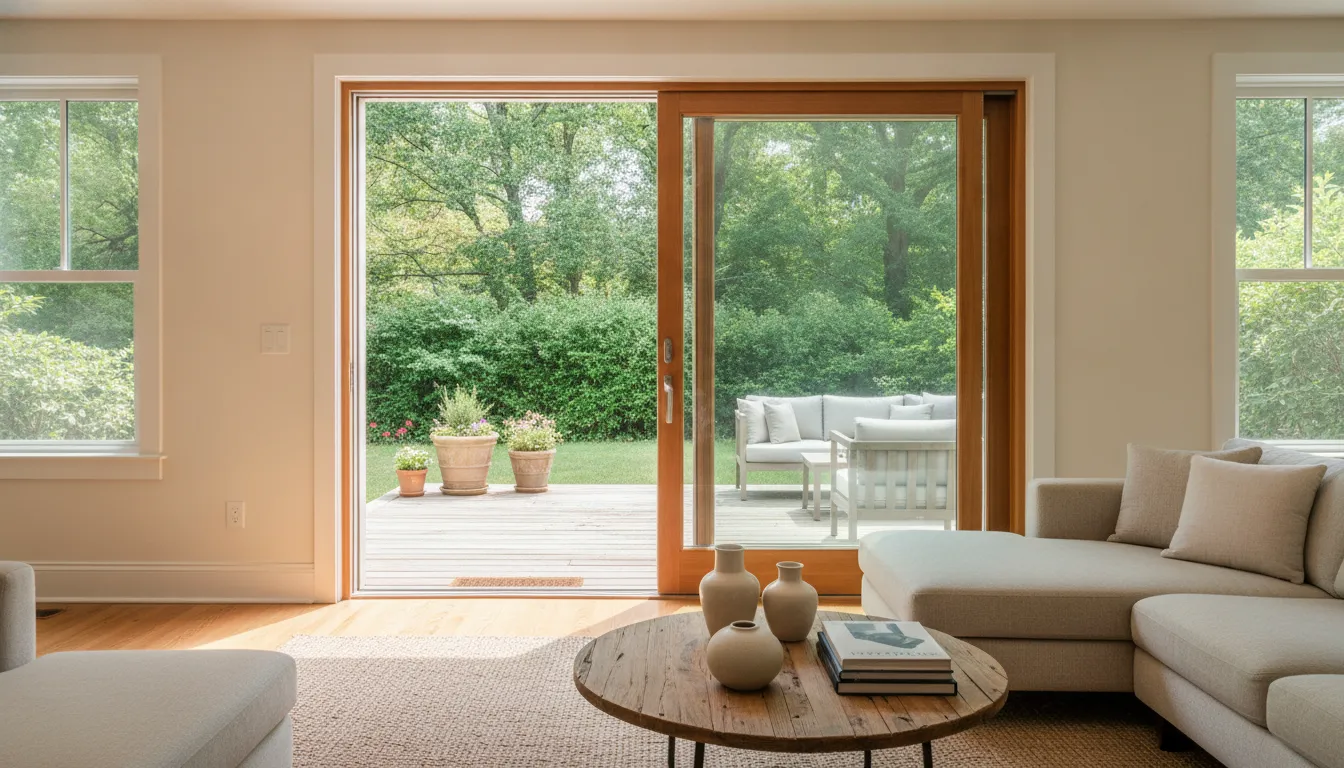
Patio doors shape how you move outside. They also set the clear space the door needs and the materials you live with every day.
The first decision is the opening, not a brochure photo. Match the door to the room in South Jersey or the Philadelphia area.
Call (856) 317-1770 to compare Andersen patio doors for your opening.
When comparing andersen patio doors, start with the opening and operation, then weigh series, material, glass, maintenance, and installation details together. Andersen's current comparison charts list gliding and hinged options across several series, but materials, sizes, and configurations vary by product, so confirm the specific unit on your quote.
A practical comparison should account for the full installation system, not just the brand name. If the wall also needs a new entrance, see front entry door replacement as a separate project. Site conditions, measurements, trim, glass package, warranty terms, and labor coverage can all affect the right choice. Cosello's Andersen page identifies the 100 Series as Fibrex composite, the 400 Series as pine with exterior cladding, and the A-Series as its architectural line. Those distinctions provide a starting point before narrowing the selection to the way your opening actually works.
Match the Series to the Opening, Not the Brochure
Start with the opening and the way your household uses the door. Andersen separates its patio-door comparison information into two charts: one for hinged and French doors and another for gliding doors. That distinction matters before you compare the 100, 200, 400, A-Series, and E-Series labels. You can review both formats in Andersen's patio door comparison charts.
Choose the operating style first
A gliding door moves along a track and can work well where a swinging panel would interfere with furniture, a walkway, or a small deck. A hinged or French door needs room to open. But it can suit an entry where you want a traditional swing and a wider opening when both panels are active. Measure the available space in the room and outside the opening before narrowing the series.
Then compare the materials
The series are not interchangeable material packages. The 100 Series uses Fibrex composite inside and out. The 200 Series options vary: Narroline has a wood interior with a vinyl exterior, while Perma-Shield uses wood and vinyl inside with a vinyl exterior. The 400 Series Frenchwood gliding door has a wood interior and vinyl exterior. Its hinged Frenchwood counterpart also has a wood interior, with a vinyl exterior.
The A-Series uses a wood interior with a Fibrex composite exterior on the hinged model, while its gliding model pairs wood inside with vinyl outside. The E-Series uses wood inside with an aluminum exterior for both formats. The 200 Series hinged door uses wood and fiberglass inside with an aluminum exterior. These differences affect the look you see from the room as well as the exterior material exposed to the weather.
Check height and panel configuration
Do not assume every series fits the same opening. Many gliding options list heights of 6 feet 8 inches, 6 feet 11 inches, and 8 feet. The A-Series also lists a 10-foot height, while the E-Series lists 6 feet 10 inches in addition to 6 feet 8 inches and 8 feet. Panel widths and available two-, three-, or four-panel configurations also vary by series. A larger opening may narrow your choices before color or interior finish enters the conversation.
Cosello is an Andersen Certified Contractor, and installation labor is backed by a 2-year labor warranty. That is separate from manufacturer coverage, which varies by product and series. For Andersen certified installation, have the opening measured and the selected configuration confirmed before requesting a final quote.
Gliding and Hinged Series at a Glance
Andersen patio doors are organized by series, operation, and material combination. The chart below brings the relevant differences into one view, while preserving the size information Andersen lists for its gliding doors. For the manufacturer's complete comparison, see Andersen's patio door comparison chart.
Size availability and finish choices can vary within a series. So treat the listed dimensions as a starting point for planning rather than a promise that every configuration fits every opening. A quote should confirm the selected operation, panel layout, materials, and available finishes.
| Series and operation | Interior | Exterior | When it tends to fit |
|---|---|---|---|
| 100 Series gliding | Fibrex composite | Fibrex composite | Openings using the listed 6'8", 6'11", or 8' heights and 5', 6', or 8' widths. |
| 200 Series Narroline gliding | Wood | Vinyl | Layouts from single panels at 2'9", 3'3", or 4'3" to two- or four-panel widths listed on the chart. |
| 200 Series Perma-Shield gliding | Wood and vinyl | Vinyl | Single- and two-panel configurations; the chart does not list a four-panel row. |
| 200 Series hinged | Wood and fiberglass | Aluminum | Hinged operation with a wood or fiberglass interior and aluminum exterior. |
| 400 Series Frenchwood gliding | Wood | Vinyl | Single-, two-, or four-panel layouts in the listed 6'8", 6'11", or 8' heights. |
| 400 Series Frenchwood hinged | Wood | Vinyl | Hinged French door operation with a wood interior and vinyl exterior. |
| A-Series gliding | Wood | Vinyl | Projects needing listed heights up to 10 ft, including two-panel widths of 5', 6', 7', or 8', plus three- or four-panel options. |
| A-Series hinged | Wood | Fibrex composite | Hinged operation where that interior and exterior material combination suits the design. |
| E-Series gliding or hinged | Wood | Aluminum | Gliding units list single-, two-, and four-panel widths; painted interiors are available on pine and maple only. |
These categories help narrow the conversation, but the right choice still depends on the opening, desired operation, interior and exterior appearance, and the configuration available for the project. Cosello can review those details when preparing an Andersen patio door quote.
Choose Gliding or Hinged for How You Use the Room
Start with the way people move through the room. A gliding patio door slides along its track, so the panels do not swing into the dining area, kitchen, or deck. That makes it useful where furniture or a narrow walkway limits clearance. It can also make a wide opening practical. Andersen's gliding-door chart lists multi-panel configurations for the 200 Series Narroline, 400 Series Frenchwood, A-Series, and E-Series, with widths varying by product and panel count. Review the official gliding-door comparison chart before assuming a preferred size is available. The chart separates single-, two-, three-, and four-panel configurations, so the opening width and desired number of panels should be discussed together.
Choose hinged when you want the familiar movement and appearance of French doors. The panels swing into or out of the opening, so measure the arc carefully and account for furniture, rugs, and traffic. Hinged options include the 200 Series, 400 Series Frenchwood, A-Series, and E-Series. Their interior and exterior materials differ by series, which can affect the look and the maintenance plan. A contractor can also confirm whether the existing opening and floor area suit the configuration.
Color availability can narrow the choice. On the 100 Series gliding door, black, dark bronze, and sandtone interiors are available only with a matching exterior color. On the 400 Series Frenchwood gliding door, the interior is white only when paired with a matching exterior. Those limits matter when the inside and outside of the home have different color schemes.
If you are still deciding between the two operating styles, read this guide to sliding versus French patio doors for a broader style comparison. When gliding fits the room, Cosello can help with South Jersey sliding patio door replacement, including opening preparation, installation, and trim.
Read the Glass Package Before You Compare Quotes
When you compare Andersen patio doors, look past the series name. Start with the glass package and its NFRC label. That label identifies the tested performance of the quoted door. It gives you a more useful comparison than assuming that one product line will perform the same in every opening.
ENERGY STAR certified doors are independently tested, certified, and verified by the National Fenestration Rating Council (NFRC). They must also meet EPA guidelines. Certification is tied to the product and its tested configuration. It is not a default claim for every door in a series.
Door criteria also depend on glazing level, or how much glass the door contains. A patio door has a lower glass-to-frame ratio than a window. That difference affects how the door is evaluated. The rating can also change when the glass package changes. For that reason, do not treat an Andersen series name as proof that the quoted door is ENERGY STAR certified. Check the NFRC label on the actual quote.
That check matters for Cherry Hill window and door projects and across Philadelphia window and door replacements. Homes here need to manage winter heat loss and summer heat gain. A quote should show the performance of the specific glass and door configuration, rather than leave you comparing broad product labels. If two quotes use different glass packages, the series names alone will not tell you which door is the better energy match for the opening.
Ask the contractor to identify the NFRC-rated glass package in writing. Then compare the labels across quotes. If the label is missing, ask for it before you make a decision. Cosello can help homeowners compare residential door options based on the quoted configuration, the opening, and the conditions the door must handle.
Measure the Opening Before You Lock a Series
A few observations before the visit can make the conversation more productive, especially when you are comparing Andersen patio doors with different panel and height options. This is preparation for the appointment, not a final measure. Cosello measures the opening on site before the replacement is quoted.
- Photograph the existing door. Take clear photos from both the interior and exterior, including the full frame, sill, trim, and the surrounding wall. These images help document the current conditions and can reveal details that are easy to overlook in a quick description.
- Record how the door operates. Note whether the unit glides or swings, and count the panels. A two-panel gliding door presents different planning questions from a single-panel or wider three- or four-panel configuration. You do not need to identify the manufacturer yet.
- Measure the visible frame. Record the opening width and height at the frame, rather than measuring only the glass. Take more than one measurement if the opening appears out of square, and note whether the overall height may exceed 8 feet. That detail matters because the Andersen A-Series gliding comparison lists a 10-foot height option, while available sizes depend on the specific series and configuration.
- Inspect the sill and floor clearance. Note whether the sill looks worn, soft, uneven, or vulnerable to water, and check the interior floor clearance if you are considering a swinging door. Furniture, flooring, thresholds, and trim can affect how much room a swing needs.
- Write down the interior look you want to keep. Bring the interior wood species or finish you prefer, along with any existing trim you hope to match. If you are considering an E-Series gliding door with a painted interior, remember that Andersen lists painted interiors as available on pine and maple only. The final series, size, configuration, and finish should be confirmed after the on-site measure.
For a broader, but still practical, patio door replacement planning checklist, review the questions to consider before the appointment without trying to replace the contractor's field measurements.
Frequently Asked Questions
What is the difference between Andersen 200 and 400 Series patio doors?
Both lines include gliding and hinged doors. On Andersen's chart, the 200 Series hinged door pairs a wood and fiberglass interior with an aluminum exterior. The 400 Series Frenchwood doors use a wood interior and a vinyl exterior, in both gliding and hinged versions. The 400 Series Frenchwood gliding chart also lists four-panel widths. The 200 Series Narroline gliding chart lists four-panel widths too, while the 200 Series Perma-Shield gliding chart shows single-panel and two-panel sizes.
What is the difference between Andersen 100 and 200 Series sliding doors?
The 100 Series gliding door is Fibrex composite on the interior and the exterior. The 200 Series gliding doors use a wood interior, or a wood and vinyl interior on Perma-Shield, with a vinyl exterior. The 100 Series chart lists 5-, 6-, and 8-foot widths. Black, dark bronze, and sandtone interiors on the 100 Series are available only with a matching exterior color.
Which Andersen series is the best patio door?
There is no single best series. A standard deck opening often fits a 100 or 200 Series gliding door. A wider opening, a 10-foot height, or a three- or four-panel layout points toward the A-Series gliding chart, which lists those heights and panel widths. E-Series is the wood-interior, aluminum-exterior option, with painted interiors limited to pine and maple. Match the series to the opening, the finish, and the swing space.
Are Andersen patio doors energy efficient?
Efficiency depends on the glass package, not the series name alone. ENERGY STAR says certified doors are tested and verified by the NFRC and must meet EPA guidelines. Door ratings also depend on how much glass the door has. Ask for the NFRC label on the exact unit in the quote before you compare two Andersen patio doors.
Does the Andersen warranty transfer if I sell the house?
Andersen describes Owner-to-Owner limited warranties that can transfer when you sell the home. Coverage still varies by series and product, so read the warranty that matches the door on your proposal. Cosello's 2-year labor warranty covers the installation work. It is separate from the manufacturer warranty.
Plan the Andersen Patio Door With a Measured Opening
A series choice gets easier once the opening, the swing space, and the finish are written down. Cosello can measure on site, compare the Andersen lines that fit, and put the glass package and labor warranty on one proposal.
Call (856) 317-1770 to plan Andersen patio doors in South Jersey or Philadelphia. Or request a free quote online.